Cosmetic dentistry
Teeth Whitening in Grays & Chafford Hundred
Professional whitening with custom-made trays, planned and supervised by a dentist, with your teeth and gums checked first.
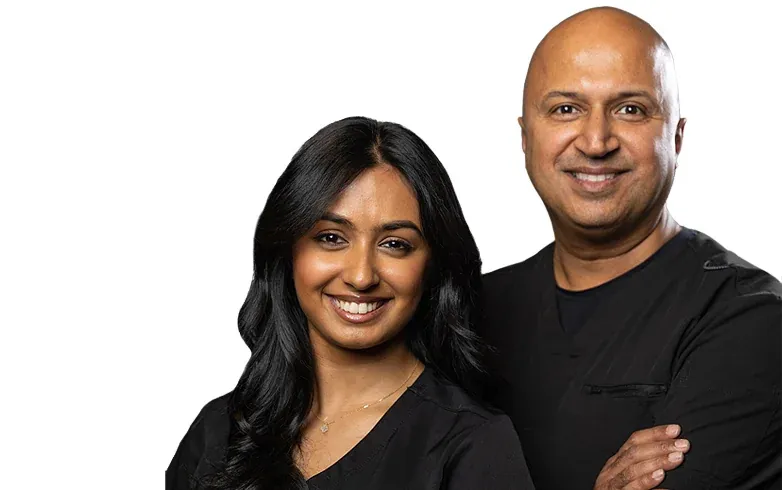
- GDCDr Jagmail Basrai, GDC 70304, qualified 1994
- POn-site parking at the practice
- M25About 1.5 miles from M25 Junction 30
- 8–5Mon–Fri 8am–5pm, Sat by appointment
- WABook on WhatsApp in a few taps
What teeth whitening can help with
- General yellowing over time
- Staining from tea, coffee and red wine
- Preparing for bonding or veneers, so the shade is right
In the UK, tooth whitening can only legally be provided by a dentist or a dental professional working under a dentist’s prescription. That is why whitening at a practice starts with an examination.
Results vary with your starting shade and the type of staining, and your dentist will be honest about what to expect.
Meet Sienna
Bright, everyday moments
Date nights, weddings and work events: the moments you want to feel bright for.
Sienna is our AI brand ambassador. She is not a patient and has not had treatment with us. She is here to celebrate the confident, everyday moments a smile you feel good about can be part of.
 AI-generated
How it works
- Check-up first. We check your teeth and gums and look at the type of staining. Whitening only works on natural teeth, not on fillings or crowns.
- Custom trays. We take a scan or impression and make trays that fit your teeth closely.
- Whitening at home. You wear the trays with the whitening gel as directed, usually overnight, and we check how you are getting on.
Teeth whitening in the UK: what the law says
Tooth whitening is a cosmetic treatment, but in the UK it is also regulated. Under the Cosmetic Products Regulations, whitening products that contain or release more than 0.1% hydrogen peroxide may only be supplied to dental practitioners, and the first use of each course must be carried out by, or under the direct supervision of, a dentist. Products above 6% hydrogen peroxide are not permitted for cosmetic whitening at all.
The General Dental Council (GDC) treats tooth whitening as the practice of dentistry. That means whitening with these products should only be provided by GDC-registered dental professionals: a dentist, or a dental hygienist or therapist working on a dentist’s prescription. Beauty salons, kiosks and mobile “whitening technicians” are not permitted to provide this treatment.
There is also an age rule. Whitening products above 0.1% hydrogen peroxide must not be used on anyone under 18, except where it is wholly for the purpose of treating or preventing disease.
Why does this matter for you? The rules exist because whitening gel works more predictably, and more comfortably, on healthy teeth and gums. A dental examination first picks up decay, leaking fillings, gum disease and exposed roots, any of which can make whitening uncomfortable or less effective. It also means you get a realistic idea of the result before you spend anything.
Home whitening vs in-practice whitening
There are two main ways a dentist can whiten teeth. Both use peroxide-based gels; they differ in where the gel is applied, how long it takes and how it fits into your week.
| Custom-tray home whitening (what we provide) | In-practice whitening | |
|---|---|---|
| Where | At home, with trays made for your teeth | In the dental chair |
| Time | Usually a couple of weeks of daily or overnight wear | One longer appointment, sometimes followed by home top-up |
| Control | You can pause, slow down or stop if teeth feel sensitive | Treatment happens in one go |
| Top-ups | Reuse your trays later with top-up gel as advised | Usually needs trays for top-ups anyway |
| Supervision | Prescribed and reviewed by your dentist | Carried out by a dental professional |
Shop-bought strips, pens and LED kits are limited to 0.1% hydrogen peroxide by law, so the change they can make is small. Some products sold online use other bleaching agents or acids that can harm enamel. If you have tried these without much change, that is common, and a dentist-led course is a different level of treatment.
Who teeth whitening can suit, and who it may not
Whitening tends to work well on general yellowing that builds up over the years, and on staining from tea, coffee, red wine and smoking. It is often the first step before cosmetic work such as composite bonding or veneers, because those are matched to your tooth shade and do not whiten afterwards.
Whitening may not be the right choice, or may need a different plan, if you have:
- Untreated decay or gum disease, which is usually treated first
- Visible crowns, veneers, bonding or white fillings on front teeth, which will not change colour
- A single dark tooth, which may be discoloured from the inside and need a different approach
- Deep grey or banded staining, which can be slower to respond and may only partly lighten
- Pregnancy or breastfeeding, when whitening is usually postponed
Your dentist will be straightforward with you about what whitening can and cannot do for your teeth before you decide.
What happens, step by step
1. Examination and shade record. We check your teeth and gums, ask about sensitivity and record your starting shade with a shade guide and photographs, so you can see the change honestly at the end.
2. Scan or impressions for trays. We take a digital scan or impressions so your trays fit your teeth closely. Close-fitting trays keep the gel on the teeth and away from the gums.
3. Fitting and instructions. We check the trays fit, show you how much gel to use and explain how long to wear them. The first use is supervised in line with UK rules.
4. Whitening at home. You wear the trays as directed, usually for around two weeks. Many people notice a change within the first week, though it varies.
5. Review. We check your progress and your gums, compare against your starting shade, and talk about top-ups and any cosmetic work you are planning.
Sensitivity: what to expect
Temporary sensitivity is the most common side effect of whitening. It usually feels like a short, sharp twinge with cold drinks or air, and tends to settle when you pause or finish treatment. Gums can also feel a little sore if gel spreads beyond the tray.
If you already have sensitive teeth, tell us at your examination. Your dentist may suggest a different gel strength, shorter wear times or a desensitising toothpaste before and during treatment. With custom trays you can take a break for a day or two if needed, which is one reason home whitening suits people with sensitive teeth.
Contact us on WhatsApp if sensitivity is severe or does not settle.
Aftercare and keeping your result
Whitening is not permanent. Teeth gradually pick up colour again from food, drink and ageing. How quickly depends on your habits.
- For a day or two after each session, many people limit strongly coloured food and drink, such as tea, coffee, red wine, curry and dark sauces
- Rinse with water after coloured drinks, and use a straw for iced coffee or fizzy drinks
- Keep up regular hygiene visits, as a scale and polish removes surface stain
- Keep your trays clean and in their case, so you can use them for top-ups as advised
- Avoid smoking, which re-stains teeth quickly
How much does teeth whitening cost?
Whitening fees vary between practices depending on the system, the number of gel syringes, whether trays are included and how many review visits are part of the course. When you compare quotes, it helps to ask:
- Is an examination included, and who checks my teeth first?
- Are custom trays included, or is it a one-size kit?
- How many syringes of gel, and what strength?
- Is there a review appointment?
- What do top-up gels cost later?
Your fee at Chafford Hundred Dental Care is confirmed in writing after your examination, before anything starts.
Teeth whitening for Grays and Thurrock
Chafford Hundred Dental Care is a private practice on Drake Road, Chafford Hundred (RM16 6SE), in the middle of Thurrock. Patients come to us for whitening from Grays and Little Thurrock (RM16, RM17), Stifford Clays and North Stifford, South Ockendon and Aveley (RM15), West Thurrock, Purfleet and Lakeside (RM19, RM20), Tilbury (RM18) and Stanford-le-Hope and Corringham (SS17), as well as from Upminster and Hornchurch across the Havering border.
Whitening with custom trays needs only a few short visits: an examination, a scan for your trays, a fitting and a review. That makes it easy to fit around work at Lakeside, the school run or a commute from Chafford Hundred station, which is about 0.8 miles from the practice. We have on-site parking and are about 1.5 miles from M25 Junction 30. We are open Monday to Friday, 8am to 5pm, and Saturday by appointment.
See also our local pages for Grays, Thurrock, West Thurrock and Lakeside and Upminster.
Why teeth change colour
Understanding why your teeth have darkened helps explain what whitening can achieve. Discolouration usually falls into two groups.
Surface (extrinsic) staining
This sits on the outer surface of the enamel and builds up from tea, coffee, red wine, cola, curry, berries, soy sauce and smoking or vaping. Some of it can be removed with a scale and polish; the rest often responds well to whitening. People who drink several cups of tea or coffee a day commonly notice this kind of staining first on the lower front teeth and along the gum line.
Internal (intrinsic) discolouration
This comes from inside the tooth. Enamel naturally thins with age and the yellower dentine underneath shows through more, which is why most of us find our teeth slowly darken over the decades. Other internal causes include a knock to a tooth that has affected the nerve, a root filling, some antibiotics taken in childhood, and too much fluoride while teeth were forming. Age-related yellowing usually responds well to whitening. Grey, brown or banded internal staining can be slower to respond and may only partly lighten.
Restorations that do not change colour
Crowns, veneers, bonding and white fillings keep the shade they were made in. If you whiten your natural teeth, older restorations can stand out more afterwards. We point these out at your examination so you can plan around them.
Whitening with fillings, crowns, bonding or veneers
Many people who ask about whitening already have some dental work on their front teeth. That does not stop you whitening, but it changes the plan.
- If you are planning new bonding or veneers: whitening usually comes first. Once your natural teeth reach the shade you want, we wait a short while for the colour to settle and then match the new work to it.
- If you have existing white fillings or bonding: these may look darker than your newly whitened teeth. They can often be polished, repaired or replaced to match, and we explain the options at your review.
- If you have a crown or veneer on a front tooth: it will stay the same colour. Some people choose to whiten to match the crown; others replace the crown afterwards to match the lighter teeth.
- If you have had aligner treatment: your aligner trays or retainers may be suitable for whitening once your attachments are removed. Ask us about this.
Timing whitening before a wedding, holiday or event
If you have a date in mind, allow time for the whole process: an examination, a short wait while your trays are made, around two weeks of whitening and a review. Starting six to eight weeks before your event gives room for any sensitivity breaks and for a top-up nearer the day.
If you are also planning bonding or veneers, start earlier still, because whitening comes first and new cosmetic work is matched once your shade has settled. Tell us your date when you book and we will plan backwards from it.
Common whitening myths
“Charcoal toothpaste whitens teeth.” Charcoal products mainly remove surface stain by abrasion. They do not change the colour of the tooth itself, and abrasive products used often can wear enamel over time.
“Lemon juice or baking soda will do the same job.” Acidic and abrasive home remedies can soften or wear enamel. Thinner enamel can make teeth look more yellow, not less.
“Whitening weakens teeth.” Prescribed whitening used as directed under a dentist’s supervision is regarded as safe for enamel. Problems are more likely with unregulated products or overuse.
“Whitening lasts for ever.” Teeth gradually pick up colour again. Keeping your trays for top-ups as advised is the simplest way to maintain the result.
“The whiter the better.” The aim is a natural, brighter version of your own teeth that suits your skin tone and face. Your dentist will talk through realistic goals with you.
Whitening terms explained
- Hydrogen peroxide
- The active ingredient that lightens teeth. UK law limits its concentration and who may supply it.
- Carbamide peroxide
- A gel that breaks down slowly to release hydrogen peroxide, often used for home whitening. A 16% carbamide peroxide gel releases roughly 6% hydrogen peroxide.
- Custom trays
- Thin, clear trays made from a scan or impression of your teeth, to hold gel closely against the teeth.
- Shade guide
- A set of tooth-coloured samples used to record your starting and finishing shades.
- Desensitising toothpaste
- Toothpaste designed to reduce sensitivity, sometimes suggested before and during whitening.
- Internal (non-vital) whitening
- A different technique sometimes used for a single tooth that has darkened after a root filling. Your dentist will explain if it is relevant to you.
Before you start: what to tell us
A few details help your dentist plan whitening that suits you. It is worth mentioning at your examination if any of these apply:
- Your teeth are already sensitive to cold, sweet or brushing
- You have had whitening before, at a practice or with shop-bought products, and how it went
- You have crowns, veneers, bonding or white fillings on the teeth that show when you smile
- One tooth looks darker than the others, or you have had a knock to a front tooth
- You are pregnant, trying for a baby or breastfeeding
- You smoke or vape, or drink a lot of tea, coffee or red wine
- You have an event coming up and a date you are working towards
- You are planning other cosmetic treatment, such as aligners, bonding or veneers
None of these necessarily rules whitening out. They simply help us choose the right gel, wear time and order of treatment, and give you an honest idea of the result.
Who provides whitening at the practice
Whitening at Chafford Hundred Dental Care is planned and supervised by our dentists, led by Dr Jagmail (Dave) Basrai, LDS RCS (Eng) 1994, GDC 70304. Your examination, shade record, tray fitting and review all take place at our Drake Road practice, and you can reach the team on WhatsApp between visits if you have a question about wearing your trays or any sensitivity.
Because whitening is often part of a wider plan, the same team can also advise on composite bonding, porcelain veneers and clear aligners, so everything is matched and timed together. See our composite bonding, veneers and smile makeover pages.
Teeth Whitening: your questions answered
How much is teeth whitening in Grays?
Your fee depends on what your course needs, such as custom trays, the number of gel syringes and a review visit. Your dentist confirms it in writing after your free consultation (a £20 holding deposit secures your slot, and it's taken off your treatment or refunded), before any treatment starts, so you know exactly what is included. Top-up gel for later use can be bought separately when you need it.
Is professional whitening safe?
Whitening is regarded as safe when it is prescribed and supervised by a registered dental professional and used as directed. We check your teeth and gums first, because decay, gum problems or exposed roots can make whitening uncomfortable. We also review how you are getting on, so any sensitivity can be managed early.
Does whitening cause sensitivity?
Some people notice temporary sensitivity, usually short twinges with cold drinks, which tends to settle when they pause or finish treatment. Your dentist will explain how to use your trays, may suggest a desensitising toothpaste, and will tell you what to do if it happens. With home trays you can take a break for a day if needed.
Will whitening work on my crowns or fillings?
No. Whitening only lightens natural teeth. Crowns, veneers, bonding and white fillings keep their original shade, so after whitening they can look darker than the teeth around them. If you have visible dental work on your front teeth, your dentist will talk you through options such as polishing, repairing or replacing it to match.
How long do results last?
Results vary from person to person and depend on your lifestyle, for example how much tea, coffee or red wine you drink and whether you smoke. Teeth gradually pick up colour again over months and years. Your custom trays can be reused with top-up gel as advised, which is a simple way to keep your shade.
Can I buy whitening online instead?
Products sold to the public are limited by law to 0.1% hydrogen peroxide, so the change they make is small, and some products sold online use acids or other agents that can harm enamel. A dentist-led treatment starts with a check-up, uses custom trays and prescribed gel, and includes a review.
How quickly will I see a difference?
Many people notice a change within the first week of wearing their trays, with a fuller result after around two weeks, but it varies with your starting shade and the type of staining. We record your starting shade with photos so you can see the change clearly at your review.
Should I whiten before bonding or veneers?
Usually yes. Composite and porcelain are matched to your tooth shade and do not change colour afterwards, so whitening first lets the new work be matched to your brighter teeth. We normally wait a short while after whitening for the colour to settle before matching. Your dentist will explain the timing for your plan.
Can I whiten my teeth if I have sensitive teeth?
Often yes, with care. Tell your dentist about any sensitivity at your examination. They may suggest a lower-strength gel, shorter wear times or a desensitising toothpaste before and during treatment. Home whitening lets you pause for a day or two if your teeth feel sensitive, which many people with sensitive teeth find helpful.
Can whitening fix one dark tooth?
A single dark tooth is often discoloured from the inside, for example after a knock or a root filling, so tray whitening alone may not even it out. Depending on the cause, options can include internal whitening, bonding or a veneer or crown. Your dentist will examine the tooth, may take an X-ray and will explain the options.
Is whitening suitable during pregnancy?
Whitening is usually postponed during pregnancy and while breastfeeding, as a precaution. It is a cosmetic treatment, so there is no harm in waiting. You can still come in for your check-up and hygiene visits, and we can plan whitening for later. Your dentist will advise you.
Can under-18s have whitening?
UK rules mean whitening products above 0.1% hydrogen peroxide must not be used on anyone under 18, except where it is wholly to treat or prevent disease. So cosmetic whitening is for adults. If a teenager is unhappy with the colour of a tooth, we can examine it and explain the options.
Is teeth whitening legal in the UK?
Yes, when it is provided by a dentist or by a dental professional working under a dentist's prescription. UK rules limit whitening products containing more than 0.1% hydrogen peroxide to dental professionals, which is why salons, kiosks and online sellers cannot legally offer the stronger gels a dentist can prescribe.
What strength of gel do dentists use?
UK rules allow dentists to prescribe products releasing up to 6% hydrogen peroxide (carbamide peroxide gels release less peroxide than their stated percentage). Your dentist chooses the product and concentration that suits your teeth and any sensitivity, and explains how to use it.
Why can't I just use a beauty salon or kiosk?
Under UK rules, whitening with peroxide above 0.1% may only be carried out by registered dental professionals. A dentist also checks for decay, gum problems and old fillings first, which can affect whether whitening is suitable and what result to expect.
Are whitening strips and toothpastes worth trying?
Over-the-counter products are limited in strength by law, so changes tend to be small, and some products sold online may not comply with UK rules. Whitening toothpastes mainly remove surface stain. Your dentist can explain what to expect from each option for your teeth.
What is the difference between home and in-practice whitening?
Home whitening uses custom trays and a prescribed gel worn over a couple of weeks. In-practice whitening applies gel in the surgery over a single longer visit. Our approach is custom-tray home whitening, planned and checked by a dentist. Your dentist will explain which suits your teeth and timescales.
How long do I wear the trays each day?
It depends on the gel prescribed. Some are worn overnight, others for shorter periods during the day. Your dentist will tell you how long to wear them and for how many days, and when to come back for a check.
What should I avoid eating and drinking during whitening?
Many people limit strongly coloured food and drink, such as tea, coffee, red wine, curry and dark sauces, while they are whitening, and avoid smoking. Your dentist will give you aftercare guidance with your trays. Drinking through a straw and rinsing with water can also help. Once treatment ends, occasional top-ups can help keep the shade you are happy with.
Can whitening damage my enamel?
Prescribed whitening, used as directed under a dentist's supervision, is regarded as safe for enamel. Problems are more likely with unregulated products or overuse. We check your teeth before starting and review how you are getting on. It is sensible to follow the wear times you are given.
What causes teeth to become yellow or stained?
Common causes include ageing, tea, coffee, red wine, smoking and some foods. Some discolouration comes from inside the tooth, for example after an injury, certain medicines in childhood or a root filling. The cause affects how well whitening works, which is why we examine first.
Will whitening help with grey or tetracycline staining?
Deep internal staining can be harder to lighten and may take longer or respond only partly. In some cases, bonding or veneers may be discussed instead. Your dentist will look at the type of staining and explain realistic options. Some stains only partly respond to whitening.
Can I whiten if I have gum disease or decay?
Gum problems and decay are usually treated first, because whitening gel on unhealthy gums or open cavities can cause discomfort. We check your teeth and gums before planning whitening. This also means any treatment needed can be done before you start whitening, and your dentist can explain how long to wait before beginning. In many cases a hygiene visit beforehand also helps, by removing surface stain and tartar.
Can I use my trays again for top-ups?
Yes. Custom trays can usually be reused with top-up gel as advised by your dentist, as long as they still fit. If you have dental work done that changes your teeth, the trays may need remaking. Bring your trays to check-ups if you would like the fit checked. Keep them clean and in their case, away from heat, so they do not warp.
Do whitening results look natural?
Results depend on your starting shade, and the aim is a brighter version of your own teeth. Your dentist records your starting shade and talks through realistic expectations before you begin. Very bright shades can look out of place against crowns, fillings or bonding that do not whiten, which is one reason we plan the shade carefully and talk about existing dental work first.
Can I whiten my teeth if I smoke or vape?
You can, but smoking re-stains teeth quickly, so results may fade sooner and top-ups may be needed more often. Smoking also affects gum health, which we check before whitening. Your dentist will talk about realistic expectations and how to keep your result for longer.
Does whitening work on dentures?
No. Whitening gel does not change the colour of denture teeth. If your denture teeth look darker than your natural teeth, or you would like a brighter denture, a new or adjusted denture may be an option. We provide dentures at the practice and can talk this through.
Can I whiten after a root filling?
A tooth that has darkened after a root filling is discoloured from the inside, so tray whitening alone may not match it to its neighbours. Internal whitening, bonding, a veneer or a crown may be discussed instead. Your dentist will examine the tooth and explain what could work.
I live in Thurrock. How do I book whitening?
Message us on WhatsApp on 07300 421405 or call 01375 481000. We are open Monday to Friday, 8am to 5pm, and Saturday by appointment. We are on Drake Road in Chafford Hundred with parking outside. You can send us your questions on WhatsApp before booking, and we will explain what happens at the consultation.
Is a whitening kit included with aligner treatment?
Yes. Chafford Aligners, Smile Tweak, Invisalign®, Angel Aligner™ and Spark™ treatment at our practice all include a professional home whitening kit.
How are custom trays different from shop-bought trays?
Custom trays are made from a scan or impression of your teeth, so they fit closely, hold the gel where it's needed and help keep it off your gums.
Do I need an examination with you if I've seen my own dentist recently?
Yes. Whitening is prescribed by a dentist, so we need to check your teeth and gums ourselves first. For whitening this is a free consultation (a £20 holding deposit secures your slot, and it's taken off your treatment or refunded).
When should I start whitening before a wedding?
Allow several weeks so there's time for your trays to be made, your whitening course and a review. If you're also planning bonding, whiten first, as composite doesn't change colour.
How should I store my whitening gel?
Follow the storage instructions that come with your gel and keep it out of reach of children.
Can I whiten if I have a fixed retainer behind my teeth?
Often yes. Your trays are made to fit around it. Your dentist checks your teeth and the retainer first.
I work in Grays. Can I fit whitening around my job?
Yes. Most whitening is done at home with your custom trays, so you only need short visits to the practice, about a mile from Grays with on-site parking.
Will whitening get rid of white spots?
Sometimes it makes them less noticeable, and sometimes they stand out more at first. Your dentist explains other options, such as bonding, if needed.
Is it a problem if I swallow some gel?
Small amounts are not usually a concern, but use only the amount your dentist shows you and wipe away any excess. Ask us if you're unsure.
How will I know how much whiter my teeth are?
We record your starting shade at your first visit so you can compare at your review. Results vary with your starting shade and the type of staining.
Related treatments
Teeth Whitening for patients across Thurrock and nearby
We see patients from Chafford Hundred, Grays and across Thurrock, Havering and south Essex.
Ready when you are
WhatsApp us to book
Message our team on WhatsApp and we will find a time that suits you. Prefer to talk? Call 01375 481000.
Messaging us on WhatsApp? See our Privacy notice for how we use your details.